A new essay in Aeon Magazine on being a Quaker and an atheist who really believes in magical stories. It's complicated. I originally titled it "In Praise of Gods That Do Not Exist," but I'm OK with the title they assigned to it: "I contradict myself."
As always, comments welcome, here or on the article itself. Enjoy!
Showing posts with label God. Show all posts
Showing posts with label God. Show all posts
Monday, August 26, 2013


Tuesday, February 5, 2013
False Appearances
With just one hand held up high
I can blot you out, out of sight.
Peek-a-boo, peek-a-boo, little Earth.
- Kate Bush, “Hello Earth”
I can blot you out, out of sight.
Peek-a-boo, peek-a-boo, little Earth.
- Kate Bush, “Hello Earth”
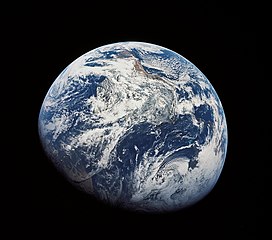
 In late December 1968, an astronaut on Apollo 8, Probably William Anders, became the first human to take a picture of the the earth in one frame. It wasn't the first photo to show the earth in one frame—unmanned satellites had created images at least two years earlier. Nor is this the iconic Blue Marble photo, which showed an entire illuminated face of the earth—that was taken four years later by Apollo 17. But I still like it, and tie it to the view of Earthrise from the Moon shown on the Apollo 8 commemorative stamp, which in turn ties to the reading from Genesis that was made by the crew on Christmas from the spacecraft.
The old spiritual goes "He's got the whole world in his hands" and when I heard Odetta sing that as a child, I thought of that new image of the world from space. It's become a cliche children learn from their youngest days: children entering the Barbara Petchenik Children's Map Competition often locate their version of the blue marble as an object of care, cared for by people... variants of the hands-around-the-world designs that in my growing up years symbolized the desire for world peace.

It's hard to visualize at the scale of a screen or a textbook page; even well-done, to-scale graphics still give the sense of a planet that can be held in hand, of a kind of fragility we could blot out with one mistake.
The planet, in fact, is staggeringly huge, especially compared to the way we commonly understand space directly, the way we make ourselves at home. There's a basic graphic in the Science Museum of Minnesota that brought this home to me last week: it shows a cross-section of a small arc of the Earth's surface, with the thin thin layer of atmosphere over the top. The distance from the top of Everest to the bottom of the Marianas Trench, a little over 12 miles difference in elevation, is about 3/1000 of the average radius of the Earth. Proportionally, it's less than the elevation distance between most people's worst pimple and the deepest scar on their skin. OK, I made that up, but it's miniscule.
Why does this matter?
It matters because we tend to bring abstracted space into human scale, and it just isn't. We look at a map of the United States, and it's a friendly looking shape (or an unfriendly one, depending how you're thinking). We don't see "vast space it would take you more than a year to walk across." And so we make incorrect assumptions how things like nations and continents and the world as a whole are unified in ways they simply aren't, and or can simply be understood in toto in ways they can't.
This is not to say they cannot be understood, but our understanding of these big spaces is, by necessity, abstract. It is not direct and personal.
Which brings me to theology. This is actually where I've been heading all along—sorry if it feels like bait and switch. But the problem of mismatched scale is one that is frankly a big one for us as modern humans. We know there are supernovae and colliding galaxies and all kinds of stuff going on in an incomprehensibly vast universe, and yet we think the God of Everything cares about our petty pain? Or on the other hand, we experience grace and love and beauty, here on our very local and personal scale, and expect that to match up with the Crab Nebula? The scale differences in how we now understand the universe to be constructed, the impersonal hugeness and incomprehensible smallness of the subatomic world (not to mention the atomic world)—these things tend to make the universality of a single (loving) God really hard to reconcile. I think (anecdotally, talking to one of my relatives, and thinking about the "amazing universe" speech I keep hearing variants of from atheists) that looking at the stars and really thinking about them has made a lot of atheists in our world.
It's one of the things that makes me just stop cold at anything even remotely like Biblical literalism. I love the story of Adam and Eve and that tree of Knowledge. There's something really important that snakes its way up through it. And reading Lloyd Lee Wilson's Essays on the Quaker Vision of Gospel Order, I understand finally the shape of the early Friends' understanding of their place in history: restoring, through Jesus, Mankind's state before the fall, when the world was rightly ordered. Essentially, if humans could all join in that Gospel Order, the universe would all be right again.
That vision of right order is so powerful. And it's a beautiful thing to think about as we look around us, right here: our home, our friends and family, our life, all in order with what should be. I want that too. But our rightness won't make the next asteroid not hit the planet and make a giant tsunami that wipes out every coastal civilization on the planet. It won't make the eventual death of our planet as the sun expands disappear. It may not even prevent global warming from radically changing what we mean by "habitable planet."
Order is scalar. Right order among people is different from right order among planets, and right order among quarks. And this is OK. It needs to be OK. What I think our job is, living here in 2013, is to figure out how to make it OK, how to live rightly in a universe that we are not, after all, at the center of. We can be the center of something—that's important—but we cannot hold the world in our hands, and there are no hands that can. We're not actually blotting out the moon, or the earth, with one hand. We're covering our eyes.
Why does this matter?
It matters because we tend to bring abstracted space into human scale, and it just isn't. We look at a map of the United States, and it's a friendly looking shape (or an unfriendly one, depending how you're thinking). We don't see "vast space it would take you more than a year to walk across." And so we make incorrect assumptions how things like nations and continents and the world as a whole are unified in ways they simply aren't, and or can simply be understood in toto in ways they can't.
This is not to say they cannot be understood, but our understanding of these big spaces is, by necessity, abstract. It is not direct and personal.
Which brings me to theology. This is actually where I've been heading all along—sorry if it feels like bait and switch. But the problem of mismatched scale is one that is frankly a big one for us as modern humans. We know there are supernovae and colliding galaxies and all kinds of stuff going on in an incomprehensibly vast universe, and yet we think the God of Everything cares about our petty pain? Or on the other hand, we experience grace and love and beauty, here on our very local and personal scale, and expect that to match up with the Crab Nebula? The scale differences in how we now understand the universe to be constructed, the impersonal hugeness and incomprehensible smallness of the subatomic world (not to mention the atomic world)—these things tend to make the universality of a single (loving) God really hard to reconcile. I think (anecdotally, talking to one of my relatives, and thinking about the "amazing universe" speech I keep hearing variants of from atheists) that looking at the stars and really thinking about them has made a lot of atheists in our world.
It's one of the things that makes me just stop cold at anything even remotely like Biblical literalism. I love the story of Adam and Eve and that tree of Knowledge. There's something really important that snakes its way up through it. And reading Lloyd Lee Wilson's Essays on the Quaker Vision of Gospel Order, I understand finally the shape of the early Friends' understanding of their place in history: restoring, through Jesus, Mankind's state before the fall, when the world was rightly ordered. Essentially, if humans could all join in that Gospel Order, the universe would all be right again.
That vision of right order is so powerful. And it's a beautiful thing to think about as we look around us, right here: our home, our friends and family, our life, all in order with what should be. I want that too. But our rightness won't make the next asteroid not hit the planet and make a giant tsunami that wipes out every coastal civilization on the planet. It won't make the eventual death of our planet as the sun expands disappear. It may not even prevent global warming from radically changing what we mean by "habitable planet."
Order is scalar. Right order among people is different from right order among planets, and right order among quarks. And this is OK. It needs to be OK. What I think our job is, living here in 2013, is to figure out how to make it OK, how to live rightly in a universe that we are not, after all, at the center of. We can be the center of something—that's important—but we cannot hold the world in our hands, and there are no hands that can. We're not actually blotting out the moon, or the earth, with one hand. We're covering our eyes.
Sunday, November 4, 2012
God Is a Really Good Story
I've been struggling for months, not with my non-theism, but with a way to frame it that reflects my sense of "yes." Our family has been attending a different Friends Meeting than we had been for over a decade, one which was founded several years ago out of a desire to have a more explicitly theist worship. A number of our friends have been involved in the group. We tried it one Sunday, and just kept going.
It would make a good narrative, I suppose, or anyway a more stock narrative, to say I was somehow converted or convinced. I haven't been, not in the way that is usually meant. But I have been sitting with a kind of "disturbance in the Force" that predates our joining Laughing Waters worship. I've spent most of this year trying to get to where this disturbance is coming from.
I had an image come to me in worship last Sunday. It was simple, but it's a puzzle, and it's not leaving me alone. It's a question, which I know is concealed behind an impenetrable wall. The question, not the answer. I don't know what the wall is (I assume it's metaphorical), and I don't know what the question is. So like the character in Kafka's "Before the Law," I'm waiting.
One thing that has been coming more clearly to me, is how I stand in relation to God. I've been getting clearer and clearer over the last few years in my non-theism, moving from a "Who the heck knows" attitude to a "I'll be really surprised if there is a God." I've been enjoying Frank Turner's joyful "no!" in his song, "Glory Hallelujah":
And within the last few months, I've come to see God as a really central, vital—and fictional— character. A really really important figure who doesn't exist factually. That feels right to me. Because it's not that Yahweh is undeserving of respect. Jesus and the Holy Spirit too. The stories in the Bible, and all the saints stories, and all the stories of what faith can do... all important.
I think the big mistake is actually trying to bring factuality into religious discussion, as if reproducible evidence will make it work better. It doesn't. Personal witness, yes. Scientific proofs, no. Why should this be?
I think we often assume that what is factual is more real than what is found in stories. As They Might Be Giants says, "Science is Real:"
But while science is about real things in the sense that it's about things we can share even with strangers, it isn't a very rich internal language, or even much of a language for intimate social interactions, as between a parent and child, or between lovers or even close friends. Part of what makes intimate human relationships work is specifically the non-reproducible results: the specific moments shared and not in need of public justification.
It's these non-reproducible results—having specific human feelings of love, hate, anger, joy, calm, or fury at specific times and places—that story-telling works with. They are not recipes, despite what folklorists and mythologists want us to think. If they were, they would have been written as recipes or maps. Instead, stories are about specific characters with whom we can parallel our own specific experiences.
Science is a kind of discussion we can have with strangers, and as such it is essential. It's hard to imagine a world in which we didn't have the dollar, and the degree centigrade, and the meter and liter and so on and on... a world where we couldn't trust in a platform of common discourse that can go as far as things like human rights.
And this is why human rights, while they are vital, are not enough. Invoking rights means we are strangers who are trying not to hurt each other. We need more than that, and most of us have more than that, in the form of love.
Love is not rational, as Mr Spock and Mr Data found over and over in Star Trek. It does not submit to measurement. But for human beings, it is clearly essential.
So how do we get from this point to a fictional God?
I was flabbergasted by this video a month or so ago. US Representative Paul Broun, who serves on the House Committee on Science, Space, & Technology, which got a wide mocking audience via Facebook:
It's flabbergasting because I've come to think of this kind of science-bashing as coming from ignoramuses, not medical doctors with public policy reach. But the more I think about the kind of religious absolutism this represents—the notion that scriptural knowledge trumps science and law, that God's truth surrounds and contains whatever petty knowledge we mortals can hope to obtain, the less it looks like the problem is that surround. The problem seems to me to be the idea that factualism is the true container for the human experience.
Facts are bits of reality we can wrap our minds around, and share with strangers. Wonder and love— and religion—are what we share with friends. So when we try and make religion factual, try to make that the gold standard for legitimate discourse, we alienate ourselves from the very intimate moments of love and transcendence we're trying to get to.
Why do we try to tell each other God is real in one way or another? Well, God is real in the same sense that our love is real, or our anger, or our fear. God is real in the same sense that any truly powerful, heart-changing story is real. Don't tell me that what rips my heart out at the end of Shawshank Redemption, or what made me feel a deep ache of mourning that lasted for days at the end of Stephen King's 11/23/63, isn't real. Of course they're real. But they are real fictions.
So. This, it seems to me, is a task before us: to confront literalism—the demand that what is important is always factually true. It isn't. And that confrontation needs to include a robust counterproposal to the argument of literalism. It needs to not try and toss out God, but to make God's proper place respectable again. A shining throne? Not my style, but if that works for you, fine. I don't care for the big royal medal ceremony at the end of Star Wars either. No, what I mean is not what kinds of trappings God deserves, but what kind of genuine respect God-stories deserve, without requiring they sound like lab reports.
And hand-in-hand with this is a recognition that the way the universe works that we have learned through scientific experiment—the truly universal and factual world—is a truer framework for the world we enter as strangers.
It would make a good narrative, I suppose, or anyway a more stock narrative, to say I was somehow converted or convinced. I haven't been, not in the way that is usually meant. But I have been sitting with a kind of "disturbance in the Force" that predates our joining Laughing Waters worship. I've spent most of this year trying to get to where this disturbance is coming from.
I had an image come to me in worship last Sunday. It was simple, but it's a puzzle, and it's not leaving me alone. It's a question, which I know is concealed behind an impenetrable wall. The question, not the answer. I don't know what the wall is (I assume it's metaphorical), and I don't know what the question is. So like the character in Kafka's "Before the Law," I'm waiting.
One thing that has been coming more clearly to me, is how I stand in relation to God. I've been getting clearer and clearer over the last few years in my non-theism, moving from a "Who the heck knows" attitude to a "I'll be really surprised if there is a God." I've been enjoying Frank Turner's joyful "no!" in his song, "Glory Hallelujah":
And within the last few months, I've come to see God as a really central, vital—and fictional— character. A really really important figure who doesn't exist factually. That feels right to me. Because it's not that Yahweh is undeserving of respect. Jesus and the Holy Spirit too. The stories in the Bible, and all the saints stories, and all the stories of what faith can do... all important.
I think the big mistake is actually trying to bring factuality into religious discussion, as if reproducible evidence will make it work better. It doesn't. Personal witness, yes. Scientific proofs, no. Why should this be?
I think we often assume that what is factual is more real than what is found in stories. As They Might Be Giants says, "Science is Real:"
But while science is about real things in the sense that it's about things we can share even with strangers, it isn't a very rich internal language, or even much of a language for intimate social interactions, as between a parent and child, or between lovers or even close friends. Part of what makes intimate human relationships work is specifically the non-reproducible results: the specific moments shared and not in need of public justification.
It's these non-reproducible results—having specific human feelings of love, hate, anger, joy, calm, or fury at specific times and places—that story-telling works with. They are not recipes, despite what folklorists and mythologists want us to think. If they were, they would have been written as recipes or maps. Instead, stories are about specific characters with whom we can parallel our own specific experiences.
Science is a kind of discussion we can have with strangers, and as such it is essential. It's hard to imagine a world in which we didn't have the dollar, and the degree centigrade, and the meter and liter and so on and on... a world where we couldn't trust in a platform of common discourse that can go as far as things like human rights.
And this is why human rights, while they are vital, are not enough. Invoking rights means we are strangers who are trying not to hurt each other. We need more than that, and most of us have more than that, in the form of love.
Love is not rational, as Mr Spock and Mr Data found over and over in Star Trek. It does not submit to measurement. But for human beings, it is clearly essential.
So how do we get from this point to a fictional God?
I was flabbergasted by this video a month or so ago. US Representative Paul Broun, who serves on the House Committee on Science, Space, & Technology, which got a wide mocking audience via Facebook:
It's flabbergasting because I've come to think of this kind of science-bashing as coming from ignoramuses, not medical doctors with public policy reach. But the more I think about the kind of religious absolutism this represents—the notion that scriptural knowledge trumps science and law, that God's truth surrounds and contains whatever petty knowledge we mortals can hope to obtain, the less it looks like the problem is that surround. The problem seems to me to be the idea that factualism is the true container for the human experience.
Facts are bits of reality we can wrap our minds around, and share with strangers. Wonder and love— and religion—are what we share with friends. So when we try and make religion factual, try to make that the gold standard for legitimate discourse, we alienate ourselves from the very intimate moments of love and transcendence we're trying to get to.
Why do we try to tell each other God is real in one way or another? Well, God is real in the same sense that our love is real, or our anger, or our fear. God is real in the same sense that any truly powerful, heart-changing story is real. Don't tell me that what rips my heart out at the end of Shawshank Redemption, or what made me feel a deep ache of mourning that lasted for days at the end of Stephen King's 11/23/63, isn't real. Of course they're real. But they are real fictions.
So. This, it seems to me, is a task before us: to confront literalism—the demand that what is important is always factually true. It isn't. And that confrontation needs to include a robust counterproposal to the argument of literalism. It needs to not try and toss out God, but to make God's proper place respectable again. A shining throne? Not my style, but if that works for you, fine. I don't care for the big royal medal ceremony at the end of Star Wars either. No, what I mean is not what kinds of trappings God deserves, but what kind of genuine respect God-stories deserve, without requiring they sound like lab reports.
And hand-in-hand with this is a recognition that the way the universe works that we have learned through scientific experiment—the truly universal and factual world—is a truer framework for the world we enter as strangers.
Friday, November 11, 2011
The Agnostic Gospel Choir
I had a blast back in August singing in a Village Harmony adult camp. The obvious highlight for me was singing the solo part of a gospel number, “Ain't Got Time To Die." It felt good, was a fun stretch for me, I'm told it sounded good... and in reflection it was a very odd choice for me.
As I've discussed earlier, though I belong to a denomination that many think is a Christian sect, I am not a professed Christian, nor do I carry may of the hallmarks of such: I do not accept Jesus as my savior, nor do I accept God as Father, or believe most of the stories in the gospels as literal, if-you-had-been-there-with-a-video-recorder-you'd-have-seen-it-too truth. I'm some flavor of agnostic, one with pretty strong non-theistic sensibilities. Deistic, maybe, but... here I am really enjoying singing gospel tunes.
OK, there's really nothing new here. I learned “Swing Low, Sweet Chariot” and all those other spiritual standards back in grade school. They were cultural artifacts—good songs from the African-American tradition. I learned a lot of them off of Weavers records: Lee Hays was a lapsed minister's son. I sing and love Christmas carols. I sang Vivaldi's Gloria and Schubert's Mass in G in school. And so on, and so on. You'll have a hard time singing choral music in this society without singing music meant for church services—but over time we've developed a framework where if it's sung in concert, it doesn't count—the whole performance has a big frame, a set of quote marks around it, just as performing in HMS Pinafore doesn't suggest you have any experience as a sailor.
Out of concert, and the frame is not so clear. When the Blind Boys of Alabama opened for Peter Gabriel a few years ago, we were all singing and dancing in the aisles, and then one of them said something to the effect of his feeling the power of the Lord and this whole hall praising Jesus, and OK fine, who am I to say otherwise, but it felt a little awkward because, well, I was singing along but I didn't mean the words literally.
Or my atheist/pagan fellow singer who got in a huff about all the religious songs—old-time gospel, mainly—that cropped up in a row at a pub sing. Or the fellow singer at the camp who wondered what his fellow Jewish friends would think about him singing gospel with such gusto.
The “frames and quotes" think only goes so far. I find a lot of the white-folky versions of spirituals I grew up with pale and even a little offensive. I joke about forming an "agnostic gospel choir" for people like me who love to sing the songs but aren't interested in being the house choir for a faith we don't really share. But as I think about it, the built-in insincerity would end up showing, one way or another. It would be fake.
Because what makes gospel work is something I just don't have that explicitly: utter commitment. Not that gospel singers are free from sin, or perfected saints in any sense, but when they sing, and sing well, it requires the whole body to dig in and hold up the song, and the lyrics are about as un-ironic as you can get. And that's part of the appeal, and it's something I and a lot of urban liberals like me simply don't carry around with us in any sort of coherent package.
As I've discussed earlier, though I belong to a denomination that many think is a Christian sect, I am not a professed Christian, nor do I carry may of the hallmarks of such: I do not accept Jesus as my savior, nor do I accept God as Father, or believe most of the stories in the gospels as literal, if-you-had-been-there-with-a-video-recorder-you'd-have-seen-it-too truth. I'm some flavor of agnostic, one with pretty strong non-theistic sensibilities. Deistic, maybe, but... here I am really enjoying singing gospel tunes.
OK, there's really nothing new here. I learned “Swing Low, Sweet Chariot” and all those other spiritual standards back in grade school. They were cultural artifacts—good songs from the African-American tradition. I learned a lot of them off of Weavers records: Lee Hays was a lapsed minister's son. I sing and love Christmas carols. I sang Vivaldi's Gloria and Schubert's Mass in G in school. And so on, and so on. You'll have a hard time singing choral music in this society without singing music meant for church services—but over time we've developed a framework where if it's sung in concert, it doesn't count—the whole performance has a big frame, a set of quote marks around it, just as performing in HMS Pinafore doesn't suggest you have any experience as a sailor.
Out of concert, and the frame is not so clear. When the Blind Boys of Alabama opened for Peter Gabriel a few years ago, we were all singing and dancing in the aisles, and then one of them said something to the effect of his feeling the power of the Lord and this whole hall praising Jesus, and OK fine, who am I to say otherwise, but it felt a little awkward because, well, I was singing along but I didn't mean the words literally.
Or my atheist/pagan fellow singer who got in a huff about all the religious songs—old-time gospel, mainly—that cropped up in a row at a pub sing. Or the fellow singer at the camp who wondered what his fellow Jewish friends would think about him singing gospel with such gusto.
The “frames and quotes" think only goes so far. I find a lot of the white-folky versions of spirituals I grew up with pale and even a little offensive. I joke about forming an "agnostic gospel choir" for people like me who love to sing the songs but aren't interested in being the house choir for a faith we don't really share. But as I think about it, the built-in insincerity would end up showing, one way or another. It would be fake.
Because what makes gospel work is something I just don't have that explicitly: utter commitment. Not that gospel singers are free from sin, or perfected saints in any sense, but when they sing, and sing well, it requires the whole body to dig in and hold up the song, and the lyrics are about as un-ironic as you can get. And that's part of the appeal, and it's something I and a lot of urban liberals like me simply don't carry around with us in any sort of coherent package.
Saturday, April 9, 2011
The humble church

I've been sitting with Philip Pullman's The Good Man Jesus and the Scoundrel Christ. It's a challenging book—probably to nearly everyone. It's no atheist screed, wiping the supernatural before it with a materialistic sneer. But it does play—lovingly—with the two sides of the character of Jesus Christ: the radical millennialist and the founder of an eternal church. It does this with the device of separating the one man into two twins. Not the easy device of a Jekyll-and-Hyde, Cain-and-Abel dichotomy; these brothers complement each other, fight each other, and end up playing parts in a story they're neither of them entirely happy with. But both seek to do the best they can do, and be the best they can be, with what has been given.
The book more or less follows the narrative content of the Gospels, along with some childhood legends. And near the end, with Jesus kneels in the Garden of Gethsemane, asking one last time for God to speak to him, to make Himself immanent to him. This paragraph has embedded itself in me:
'Lord, if I thought you were listening, I'd pray for this above all: that any church set up in your name should remain poor, and powerless, and modest. That it would wield no authority except that of love. That it should never cast anyone out. That it should own no property and make no laws. That it should not condemn, but only forgive. That it should be not a palace with marble walls and polished floors, and guards standing at the door, but like a tree with its roots deep in the soil, that shelters every kind of bird and beast and gives blossom in the spring and shade in the hot sun and fruit in season, and in time gives up its good sound wood for the carpenters; but that sheds many thousands of seeds so that new trees can grow in its place. Does the tree say the the sparrow "get out, you don't belong here?" Does the tree say to the hungry man "This fruit is not for you?" Does the tree test the loyalty of the beasts before it allows them into the shade?I don't really have much to add. I think Pullman's vision of the kind of church Jesus would have put up with is spot on, and is a challenge even for the liberal sect I belong to. I think I need to carry this around with me some more.
Sunday, February 13, 2011
Saving the Universe, one novel at a time

Meanwhile, I am getting tired of the idea of actually saving the Universe, or the Earth, or Life. I am getting tired of people who overstep their truth. I just get tired of feeling like I need to clean up after radical theoreticians when I read them, like I have to measure every sentence to see if they are still speaking from experience or generalizing out into an barely-tenable conclusion. And I think it's like the idea of our "saving the Earth" or "saving life on Earth": Folks, we'd have to work pretty damned hard to actually wipe out microbial life, or even vertebrate life, or even mammalia, let alone primates, let alone Homo Sapiens. "Western civilization" I can see getting wiped out over some lengthy period of time, though it will take some doing to wipe away so much printed and absorbed knowledge. And what hubris to think we can "save the Earth." It is large, and contains unbelievable multitudes. (see this post by Keith Humphreys that pretty much sums it up for me)
I've noticed for a long time in movies and comic books and fantasy novels, that when there's a battle for the Universe, it usually takes place in the author's backyard. Wherever the author lives, that's where the Ultimate Conflict will be. So Tom Clancy has a showdown in Washington, Harry Potter and Doctor Who in England, Godzilla in Tokyo... somewhere there's a Malaysian hero-movie with the Ultimate Battle in Kuala Lumpur, and a telenovela with the world-saving hero's sword is locked in combat somewhere near Buenos Aires. Probably the dolphins have a long-running series on the Ultimate Battle With the Orcas of Puget Sound.
There is something wonderful about your own backyard becoming the center of the universe. English fantasies do this well: old battles that were, for their participants, the center of creation—the invasions of Celts, Romans, Anglo-Saxons, Vikings, Normans; the endless wars since—are placed against the determinedly bucolic and ordinary lives of our lead characters, living in undramatic late-twentieth-century England.
American fantasy writers struggle to do this as effectively. I have often wondered why this is. For a long time I wondered if it's because, with the exception of Native American religions and the Mormons, we do not have the Center of the Universe posited here by our religions. But I'm coming to wonder if it has more to do with the fact of fighting over land. The English are just as uncentered religiously: yes there's Canterbury, but the Holy Land is as religio-centric as it is here in North America.
No, I think the depth of people physically battling over land may be the key. There are few battlefields here in North America, and what there are are mostly framed as battles over principle rather than invasions. Really only Euro vs Native wars qualify in the same way as those repeated invasions of England, and those are a still a little crisply engraved in our cultural memory to work as the resonant underpinning to fiction, and the descendants of Europeans remain on the side of the Normans and the Vikings... the bad guy invader side. I wonder what it will take, in terms of action and the erosive quality of time, for us to get past the American equivalent of Ivanhoe-ish divisions.
Saturday, September 4, 2010
The God Thing
[lightly edited after first being published so the "ands" and "buts" make a bit more sense...]
Chris posted on FaceBook:
Magic may not be real in the same sense that the sofa I'm sitting on is real, but then neither is love real in the same way. I believe God as a person is a human construct made to explain and give sensible shape to an observed set of patterns in the world. I don't believe God has personhood in and of itself.
Actually, I think God is the strawman in this, in that there are so many shapes and visions and experiences that all get lumped together, and everyone who "believes in God" ends up actually believing in a subset of them, either through their own conscious choice or more often through personal experience and social pressure.
I think of it in the abstract as the difference between matter and energy: we can't see energy, only its effect upon matter. Some energy is utterly chaotic at a human scale (the weak and strong atomic forces, for example, are way too fast and small to register with us, and the resulting molecular interactions, or even the basic chemical reactions of living cells, happen at staggeringly rapid, small-scale speeds). Other evidences of energy (Hurricane Earl for example) have clear, directional force but a mindless intent. This sense of a hurricane's mindlessness is comparatively new: people may pray for a miracle, but few liberal religionists really understand God as the one who puffs His breath and makes the tornado wipe out one house and not the other. On the other hand, there are still plenty of people out there who think God decides baseball games. Or who believe in good luck charms.
And then there's energy with intent: life. Weeds that "want" to grow into the tomato patch, the virus that "wants" to take over your body. Love. War. My point is, while living things are concrete, life itself is essentially defined by the flow of energy through these concrete systems.
Now, I do not personally believe in a cosmic mind, in the sense that humans have minds and individual wills. I think a Universal Will looks an awful lot like gravity, in that it's things we really don't think of fighting. But, of course, people do fight gravity all the time. And death. And taxes, but that's only marginally related to the topic here. And I'd argue that the fight is not on the whole a good thing. Dancing with gravity and death, sure, but in the end they will win. Your plane will need refueling, and you will eventually die.
On the other hand, I see people rely on the cosmic mind, aka God the Father or the Trinity or Allah or Jehovah, or whichever construction the particulars of their faith entails. And for the most part, it seems to be a force for good in their personal lives. Now, I know about Messrs Falwell, Swaggart, Roberts, Robertson et al. And pedophile priests and Osama bin Laden and suicide cults. But I see that none of these perversions could have existed without the love and trust created amongst people: there has to be something real there for demagogues and opportunists to twist to their own advantage; something internally forceful and good that people can be persuaded is threatened by external forces. But for the people themselves, this God thing seems to heal them, support them, and frankly make them better able to play with others.
Which is where I am right now: that it isn't actually all that important to show that God has physical manifestation, or that it can be measured and recorded. But as part of a religious organization or two (if you count my marriage as an organization), I want to see how we can make a place where folks like me on one hand, and folks who live a life with God on the other, can live together and learn from each other, as opposed to beating each others’ orthodoxies over each others’ heads.
Chris posted on FaceBook:
I'd like to join Robert and Glenn and simply observe that if you accept that magic isn't real you don't have to worry about making such distinctions. It really does make life a whole lot easier. There is neither God the Father nor God the Judge. There simply is no God, or god.and I responded:
Chris: Hmm. That's kind of a put up or shut up statement there. So I'll put up in a blog post... Too long to post here... And thanks for being blunt!I've kind of resisted any real statements of faith: little pieces here and there, but maybe I ought to just put out there where I stand on this basic "is there or isn't there" thing:
Magic may not be real in the same sense that the sofa I'm sitting on is real, but then neither is love real in the same way. I believe God as a person is a human construct made to explain and give sensible shape to an observed set of patterns in the world. I don't believe God has personhood in and of itself.
Actually, I think God is the strawman in this, in that there are so many shapes and visions and experiences that all get lumped together, and everyone who "believes in God" ends up actually believing in a subset of them, either through their own conscious choice or more often through personal experience and social pressure.
I think of it in the abstract as the difference between matter and energy: we can't see energy, only its effect upon matter. Some energy is utterly chaotic at a human scale (the weak and strong atomic forces, for example, are way too fast and small to register with us, and the resulting molecular interactions, or even the basic chemical reactions of living cells, happen at staggeringly rapid, small-scale speeds). Other evidences of energy (Hurricane Earl for example) have clear, directional force but a mindless intent. This sense of a hurricane's mindlessness is comparatively new: people may pray for a miracle, but few liberal religionists really understand God as the one who puffs His breath and makes the tornado wipe out one house and not the other. On the other hand, there are still plenty of people out there who think God decides baseball games. Or who believe in good luck charms.
And then there's energy with intent: life. Weeds that "want" to grow into the tomato patch, the virus that "wants" to take over your body. Love. War. My point is, while living things are concrete, life itself is essentially defined by the flow of energy through these concrete systems.
Now, I do not personally believe in a cosmic mind, in the sense that humans have minds and individual wills. I think a Universal Will looks an awful lot like gravity, in that it's things we really don't think of fighting. But, of course, people do fight gravity all the time. And death. And taxes, but that's only marginally related to the topic here. And I'd argue that the fight is not on the whole a good thing. Dancing with gravity and death, sure, but in the end they will win. Your plane will need refueling, and you will eventually die.
On the other hand, I see people rely on the cosmic mind, aka God the Father or the Trinity or Allah or Jehovah, or whichever construction the particulars of their faith entails. And for the most part, it seems to be a force for good in their personal lives. Now, I know about Messrs Falwell, Swaggart, Roberts, Robertson et al. And pedophile priests and Osama bin Laden and suicide cults. But I see that none of these perversions could have existed without the love and trust created amongst people: there has to be something real there for demagogues and opportunists to twist to their own advantage; something internally forceful and good that people can be persuaded is threatened by external forces. But for the people themselves, this God thing seems to heal them, support them, and frankly make them better able to play with others.
Which is where I am right now: that it isn't actually all that important to show that God has physical manifestation, or that it can be measured and recorded. But as part of a religious organization or two (if you count my marriage as an organization), I want to see how we can make a place where folks like me on one hand, and folks who live a life with God on the other, can live together and learn from each other, as opposed to beating each others’ orthodoxies over each others’ heads.
Subscribe to:
Posts (Atom)
