Showing posts with label love. Show all posts

Saturday, April 20, 2013

Old Books 4: The Bone People

I got this book in Cornwall in 1986, for no particular reason, and read it the peculiar haze of being a barkeep at a holiday resort on a bluff near Perranporth. It was an odd and stranded summer, and this is an odd and haunted book.

It is filled with fierceness: fierce humor, fierce love, and fierce violence. It concerns a trio of characters: Kerewin Holmes (an obvious counterpart to the author, Keri Hulme), a woman who won the lottery, and saw her talent for painting and life shrivel into the tower she built with the proceedings; Joseph Gillayley, whose beloved wife and son died, and who is left caring for Simon, who is autistic and prone to violent rage. Joe gives back in kind, savagely beating the boy.

You'd think with a set up like that you'd end up with a gothic abbatoir of a book. But it isn't. Love and violence are not mutually exclusive in this world—indeed, in reading bell hooks' Something About Love many years later, I found I simply couldn't stomach her calm assurance that "where there is violence, there is no love" precisely because the vision of Joe and Simon kept returning.

It's not that they like hurting each other. It's not S&M in family form. But they do enact their rages back and forth around the room. In what some critics say should have been the finale, Simon smashes Kerewin's beloved guitar, and she tells him to go to hell. Joe enraged, beats him senseless. Before losing consciousness, Simon pulls out a long sliver of glass he has saved away, and neatly inserts it into his stepfather's gut. So, yes, I guess it is an abbatoir.

But it isn't the finale. Broken—Kerewin with a cancer, Joe with time in prison and lost relationship with his family, Simon made deaf and permanently injured by the final beating—they each go to the land in one way or another, and are healed. And that's the message Hulme gives to us in the end: that the fires of fierceness that tie us to the land are the same fires of violence that are a part of Maori culture (did I mention that all of this takes place on the South Island of New Zealand, and that Kerewin and Joe are Maori?), and that it's not a matter of putting those flames out, but of turning them on to what needs the flame.

The whole thing makes me question the smug way we liberals often talk about violence as inherently, utterly wrong. It's not that any character in this book is happy about being violent towards anyone else (although Kerewin smugly puts Joe in his place once with advanced aikido moves). But I think Hulme is saying that neither is violence something we can cut out of ourselves. To me, this book is a puzzle. After more than 25 years, I'm still working on it.

Sunday, December 16, 2012

Angry

It's been eleven years since I was this angry, sad, and generally rendered incapable of much useful work. It's shocked me how hard the last two days have been: I mean, yes, it's awful—twenty first graders shot dead in their classroom, and the teachers and principal and so on. Of course it's awful. But there have been lots of awful things over the last ten years.

I'm not alone in this. Something about the events in Newtown have made us as a nation viscerally, boiling-over angry in a way that we haven't seen since 9/11/01. We are grief-stricken in a way we don't know what to do with.

I realized tonight that underneath the weeping for those 20 six- and seven-year-olds is something bigger. I am weeping for my country. I am weeping for the sense that this is becoming a place that isn't mine anymore. But I'm not from anywhere else. This is my home. I'm an American.

It isn't cheap political rhetoric. I spent a few days in Toronto on September, and it was such a startling weight off of me, walking through the streets of a very urban, gritty, full-of-urban-problems city, and not feeling the sense of anxiety that hangs even over my nice hometown of Minneapolis. It was like losing a headache I'd forgotten was there.

Toronto's no paradise. Canada's no paradise. I'm probably never moving to Canada. But I just don't get how so many people, including some of my friends, look at Canada and Western and Nothern Europe, and sneer at universal health care and pooh-pooh the lack of gun violence. I could quote figures at you, but I don't want to here. That's not the point. The point is, I felt more at home and at peace in a strange city than I do in my own front yard. I found that profoundly unsettling.

I am angry, angrier than I've been willing to admit to myself. I cover it up pretty well most of the time, I think—both from others and myself—but what I've seen in some of my liberal friends—the bitterness and fatalism—well, I worry I'm coming down with it too. I love my country, and I want it to be a place of love and peace. That's the picture I grew up with, and as I get older, I realize most of my fellow Americans have either given up on that vision as childish, or never had it in the first place. Instead it's a nation filled with demons needing to be stomped out with vigor. No dream of a better place in the here and now, just a resigned sigh that the battle is never won, and hope for peace in the next world.

But we're the nation that made a great industry out of dreams and fantasies. You'd think we'd know better, that we could learn to harness this great national talent for self-invention, and become a nation of Ray Bradburys. But we're not. We produce Ray Bradburys in a way no other country could, but the fantasies we adopt as our national scripts are full not of magic and hope, but of moralizing and fear and brimstone.

We are not the Greatest Nation on Earth. Whoever said that anyway? It sounds like a P. T. Barnum line. It's cheap boasting, and we've always been good at that. But we've also been good at self-deprecation, and we've been sorely lacking that in our national debate lately, outside of Comedy Central. Maybe we were the greatest nation on earth for a while after World War II, but we didn't even get to enjoy it, because we were so consumed with hate for dissent and fear within ourselves.

I love my country, but my country lies to itself. It hates itself. It's like loving someone with anorexia: their body image doesn't match their body, and becomes an ugly tool of self-mutilation, instead of a guide to positive change.

I am angry that we need revisionists like Howard Zinn (We who live in a nation that prides itself on a clarity and practical know-how. No fancy theories with abstact thises and thats—we leave that to the old world. No outdated, ossified social hierarchies). But we need the Howard Zinns to to show us how we have lied and lied again to ourselves. Lies upon lies. No fancy theories, just plain bald-faced ignorance of evidence and stubbornness. We let people say science is just someone's opinion, and all opinions are equal, and so it doesn't matter a whit how much research and effort you've done.

Jonathan Haidt thinks liberals don't care about sanctity and loyalty and respect. We do. I do anyway. And it hurts to think that what was sacred, what I want to be loyal to, and respect, has been dragged through the filth, betrayed my loyalty, and unearned my respect.

I want to live in a country where ideology is not king, especially ideology that masks rapaciousness and greed. I know we're never going to be rid of ideologues, and that's OK. But the floor of our national sense of self is rotting from underneath, and all we seem to be able to summon the collective will to do is tap on the floor with our foot and complain about the funny smell, and argue about whose job it is to hire the contractor and whether we really ought to pay for new sills.

And weep when twenty children fall through the hole and into the basement, gone forever.

Wednesday, December 21, 2011

Inheritance and Stewardship

One of the first committees I was asked to be on at Twin Cities Friends Meeting, was to address concerns about care of the meetinghouse. The problem was that the meeting couldn't get enough people to serve on the committees responsible for the physical plant, and the long-serving members who had led those committees were aging out of their ability to handle everything themselves. One of the questions we asked early on was how we could bring a sense of spiritual life to the mundane issues of physical plant maintenance.

There are plenty of traditions in which spiritual practice is bound up with work. In some traditions, prayers are counted out along with repetitious labor. In others, focused concentration on a task is used as a way to remove distraction from worldly concerns. Christian monastic traditions engage their followers in work—hard work—as part of their humble duties to God.

We aren't monks, and the work in question was not made of boring, iterative tasks like planting or wall-building. It was things like fixing the toilet and maintaining the furnace, making sure the building was vacuumed and the walks shoveled and the grass mowed.

Where we ended up, was that we wanted to emphasize a sense of "stewardship," that this was not just one more job in our daily lives, but care for a space that was built collectively for the benefit of a greater whole. This was in contrast to emphasizing "property," the value of which is worldly wealth. Stewardship suggests that we are caretakers rather than owners—a steward is not the owner of an estate, but the manager on behalf of the owner, whose job is to make the property do what the owner wants. If we regard the assets of the Meeting as in our care rather than in our keeping, the sense was, it will give that care a greater sense of spirit-led purpose.


There has been a lot of talk about wealth recently in the public sphere. The Occupy movement uses the "99%" and the "1%" as rallying points, noting an increasing concentration of wealth over the past few decades. Conservative commentators, in turn, argue that we ought to be able to enjoy what we earn—that communist redistribution ends up sapping the initiative out of an economy.

The piece I keep thinking is being left out is the matter of inheritance. Not in the broad collective sense liberals like to trot out ("what kind of a world are we leaving our children"), although that is of course important. What I keep wondering about is specifically what parents leave to their children.

Now, I have been the beneficiary of lots of generous inheritance. My mother's parents effectively paid my way through high school and college, and the inheritances from my grandmother and my wife's grandmother made the bulk of the down-payment on our house. When I've gotten myself into sticky financial spots over the years, especially in my first ten years out of college, my parents bailed me out… nothing mind-boggling, but help that got me more quickly over bad decisions. I'm very grateful for these inheritances, and even more so as I now find myself in the position of parent.

As a father, I so want to "be there" for my son. I want to give him all I can. At the same time, I don't want to spoil him, or have him never learn form not getting what he wants. And he doesn't always get what he wants, as he will be happy to tell you.

I think the question of how to bequeath to my child goes back to the question we were asking in the Meetinghouse Care committee. Is what I am giving my child his property for him to work his will upon, or is it something he needs to take care of? To invoke stewardship doesn't necessarily affect inequality of inheritance—the sense of stewardship is a long-running theme among large land-owners in England, for instance. But when it's brought together with questions of collective versus individual ownership, it affects how we go about transferring wealth to the next generation. Is that transfer for the benefit of our child or for the continued health of the stewarded property?


A lot of our fears for our children come about because we don't trust the collective community to care for individuals. We have to care for them ourselves while we can, and train them up to take care of themselves. We wish we could do otherwise, that we could let them rest in the arms of the whole, but we don't. Some of us live in smaller communities that have some of that trust—religious communities especially, in this country, but also communities like those that came together out of the gay community in the AIDS horrors of the 1980's and 1990's.

If it came down to it, in a collapse of civilization, we'd find and make communities. Mad Max aside, we have the basis for real support and care in times of need already. In my own life, the morris dancing community, meeting, my work community, my family, and my neighbors (well, some of my neighbors) would form webs of care. We'd do what we could for each other.

But we as a nation do not trust the nation, or even our individual states, to provide that network. We depend on that national framework to hold up our economy: we have a common, nationally determined currency and laws that form the basis for most of our work outside the home. But it's clear from the way politics are headed that we simply don't want to trust our lives to this nation. There is something in that collective we do not want to give to our children.

Is it racism? Classism? Culturalism? Some unholy mixture of all our group-identity-based biases? A lot of my friends would tell you yes, that is the fundamental problem. And I agree they are problems. But they all run up against the question of personal inheritance: when we give our child this package, it includes everything, warts and all.

When we look at what we give our children in terms of fungible value—give them liquid assets so they have the freedom to do what they can with it—without also looking at the thing we are giving into their care as a thing that needs care in and of itself, we are also giving them the idea that fungible value is what is important in a thing. In short: when we give our children freedom, we also give them the false idea that they are free from responsibility.

On the other hand, too many wealthy parents give their children specific, non-liquid inheritances that those children simply aren't fitted to: children who drive their parents' company into the ground, who don't care about the old house and let it rot, who don't want to take care of that stupid artwork... Or who understand the value in these things but don't really carry it in their hearts, and so lose their souls in what their parents or grandparents acquired. They own but they do not love.


I don't see an instant way out of this knot, except that we need to rethink what it means to leave things to our children.

Friday, December 31, 2010

Great Work of Time

Who hasn't run into old Shelley's "Ozymandias" in an English Lit class, the ruined claim of eternity disintegrating back into sand. We think we are free of the pride of our permanence—the mortality of ourselves and our endeavors gets drilled into us over and over: hubris and vanity and the problem of seeking immortality (cf. Voldemort).

I just finished rereading John Crowley's Great Work of Time, a compact, melancholy and thorough dismantling of the idea of an eternal empire. It's a time travel story in baldest terms—one where the attempt to make the British Empire truly eternal, the protector of world peace and preventer of the horrors of the twentieth century, turns out to make the world go horribly wrong: the future fills with monsters and angels, a strange and unnatural stasis that in the end is imagined as a silent forest underwater, forever still and unchanging. The angels and the wise magi that the messing with time produces, do not want to have been created. They long for death.

We mapmakers make some claim of permanence—more modest than eternity, but what I take away from Crowley's book is the false seductiveness of the idea that what lasts beyond our lives lasts forever. We don't know what happens after "The End," and so we imagine a universe that never ends, an empire on which the sun never sets. An immortal soul. Streets that are somehow permanent. But someday the streets in my neighborhood will become meaningless. It might be a very very long time (in doing research this week I realized I will likely live to see the basic streeet pattern of Harvard Square celebrate its 500th anniversary), but there is no such thing as "forever", only "over the horizon." I don't think there is anything, anyway.

Maps only act as a way of contrasting relatively transient with relatively permanent phenomena: the states shapes remain the same as votes move from bloe to red and back again. Streets remain the same as taxi routes wiggle back and forth across them. Continents retain their rough outlines as glaciers push forward and retreat.

We need ground to stand on—a stage as I've said before, here—in order to make our performances and arguments. People who have attempted to eliminate that stage in the name of acknowledgining our impermanence have unleashed a peculiar kind of madness we see in some kinds of modern art and philosophy. Eliminate permanence, and there's no "there" there, as Ms Stein said. Perhaps the answer is to sadly acknowledge that our stage, our permanence, is itself impermanent, and find a platform that fits our lives, and the terms of permanence we can find— the land that stays more-or-less the same between glaciations, the nation that for a while retains the same basic shape, the family and friendship we have for the span we are lucky enough to have it.

Happy New Year, all. Here's to what permanence we can muster in the coming year, and what good we can perform upon that permanence.

Thursday, October 21, 2010

Tecumseh Sparrow Spivet

[Note: this article presumes reading the book, and contains spoilers]

I have a few things to say about The Selected Works of T.S. Spivet.

The novel was a best-seller when it came out in June of 2009, and initially received press attention because of the monumental advance the author Reif Larsen received for this first novel ($1 million). The reviews were mixed: most reviewers wanted very much to like such an unusually eloquent and evocative voice, but several (notably the New York Times and Washington Post reviewers) found the latter part of the book, especially the parts where T.S. Spivet visits Washington, disappointing.

Well, to be honest, they weren't my favorite bits either. But then, they also weren't T.S.'s favorite, and it kind of shows. The book, like most maps, doesn't entirely work as a linear narrative. It's a puzzle in which the linear progression of time and plot, while certainly straightforward (this is no Memento), is not the dominant, salient feature. Really, the most important moment is about 2/3 of the way through, when, at the conclusion of reading his mother's reconstruction of his great-grandmother's early life story, she abruptly cuts off the narrative, writing the name of T.S.'s dead brother, who perhaps died as she was writing. In this sense, it's a little like the symmetry of Coleridge's "Rime of the Ancient Mariner", where the second half of the novel has the character working his way from that crux point, the nowhere of a midwestern wormhole, back to his family. Coleridge's Mariner's return journey also suffers somewhat...

The way T.S. simultaneously orbits his brother's death and avoids it that forms the central motion of the book. And an orbit is hardly a linear path: we return again and again to the same basic relationships: T.S.'s distant, formal relationship with both his scientist mother and cowboy father, his typically exasperated coexistence with both his living and deceased siblings, his obsession with drawing diagrams and maps as a way of making sense of the world, and the utter senselessness offered up by the world that he tries to map.

---
This is the second book about map people I've read this year. Unlike the author/subject of Map Addict (see my discussion here), the fictional narrator of this book is consumed by the promise of mapping and more generally of scientific study of the universe. It's appropriate that the character be a child—a prodigy with an disturbingly grown-up diction (and who has not known children with disturbingly grown-up diction)—but it is also notable, and lovely, to see a cameo appearance by Corlis Benefideo, the subject of Barry Lopez's short story "The Mappist" (see discussion here). And it's clear that Larsen wants his hero to be like the narrator's daughter in that story—the promise of a new generation who will humbly carry on the Work of mapping the world, piece by piece.

It's not how us cartographers usually see our role, any more than "making myths" being how novelists consciously view their craft as they go about it from day to day. But Larsen is pointing in this circular, spiraling book to the same basic sense Lopez pointed to: the humble recording and exploring and searching and the piece-by-piece processing of it all, is a kind of prayer to the universe. It's a kind of love.

So it really is a peculiar novel. It points toward what it's trying to say, leaving the largest points mostly unsaid, like notes at the edge of the map saying this destination is a certain distance further. We find a genius cartographer running into things that are unmappable and yet that mapping is his tool. We see a desire to be part of a great scientific enterprise crumbled into disillusionment, but not disillusionment with the enterprise, just with the clothes it has to wear—T.S. may be saying goodbye to the Smithsonian and to Washington, but not to the idea of the Smithsonian.

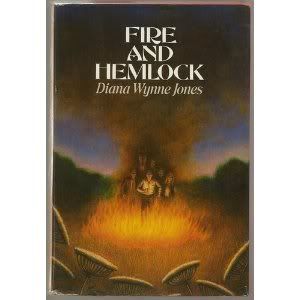
I keep seeing these sorts of orbits underlying some of my favorite books. The orbit in Diana Wynne Jones' Fire and Hemlock is deceptive—it's a love story that orbits a kind of modernist despair. Here, the obvious suppressed and not-so-suppressed grief over T.S. brother's death looks like the focus of the orbit. T.S. clearly thinks it's what he's circling. But in the end, what is revealed a kind of stubborn, slow trust that some of the world is comprehensible. Even the terrible, stupid meaninglessness of his brother's death. In the end, the author (and narrator) point towards the love of parent and child, the care even the most scientific of us end up showing each other, that he has been circling, unaware, for the entire novel.

Saturday, September 4, 2010

The God Thing

[lightly edited after first being published so the "ands" and "buts" make a bit more sense...]

Chris posted on FaceBook:
I'd like to join Robert and Glenn and simply observe that if you accept that magic isn't real you don't have to worry about making such distinctions. It really does make life a whole lot easier. There is neither God the Father nor God the Judge. There simply is no God, or god.
and I responded:
Chris: Hmm. That's kind of a put up or shut up statement there. So I'll put up in a blog post... Too long to post here... And thanks for being blunt!
I've kind of resisted any real statements of faith: little pieces here and there, but maybe I ought to just put out there where I stand on this basic "is there or isn't there" thing:

Magic may not be real in the same sense that the sofa I'm sitting on is real, but then neither is love real in the same way. I believe God as a person is a human construct made to explain and give sensible shape to an observed set of patterns in the world. I don't believe God has personhood in and of itself.

Actually, I think God is the strawman in this, in that there are so many shapes and visions and experiences that all get lumped together, and everyone who "believes in God" ends up actually believing in a subset of them, either through their own conscious choice or more often through personal experience and social pressure.

I think of it in the abstract as the difference between matter and energy: we can't see energy, only its effect upon matter. Some energy is utterly chaotic at a human scale (the weak and strong atomic forces, for example, are way too fast and small to register with us, and the resulting molecular interactions, or even the basic chemical reactions of living cells, happen at staggeringly rapid, small-scale speeds). Other evidences of energy (Hurricane Earl for example) have clear, directional force but a mindless intent. This sense of a hurricane's mindlessness is comparatively new: people may pray for a miracle, but few liberal religionists really understand God as the one who puffs His breath and makes the tornado wipe out one house and not the other. On the other hand, there are still plenty of people out there who think God decides baseball games. Or who believe in good luck charms.

And then there's energy with intent: life. Weeds that "want" to grow into the tomato patch, the virus that "wants" to take over your body. Love. War. My point is, while living things are concrete, life itself is essentially defined by the flow of energy through these concrete systems.

Now, I do not personally believe in a cosmic mind, in the sense that humans have minds and individual wills. I think a Universal Will looks an awful lot like gravity, in that it's things we really don't think of fighting. But, of course, people do fight gravity all the time. And death. And taxes, but that's only marginally related to the topic here. And I'd argue that the fight is not on the whole a good thing. Dancing with gravity and death, sure, but in the end they will win. Your plane will need refueling, and you will eventually die.

On the other hand, I see people rely on the cosmic mind, aka God the Father or the Trinity or Allah or Jehovah, or whichever construction the particulars of their faith entails. And for the most part, it seems to be a force for good in their personal lives. Now, I know about Messrs Falwell, Swaggart, Roberts, Robertson et al. And pedophile priests and Osama bin Laden and suicide cults. But I see that none of these perversions could have existed without the love and trust created amongst people: there has to be something real there for demagogues and opportunists to twist to their own advantage; something internally forceful and good that people can be persuaded is threatened by external forces. But for the people themselves, this God thing seems to heal them, support them, and frankly make them better able to play with others.

Which is where I am right now: that it isn't actually all that important to show that God has physical manifestation, or that it can be measured and recorded. But as part of a religious organization or two (if you count my marriage as an organization), I want to see how we can make a place where folks like me on one hand, and folks who live a life with God on the other, can live together and learn from each other, as opposed to beating each others’ orthodoxies over each others’ heads.

Tuesday, September 15, 2009

'Til Daddy Takes the T-Bird Away

Ingrid posted a passage on the fridge a while back from Malcolm Gladwell's book Outliers. The relevant passage is quoted here. It basically makes the case that it is practice—massive amounts of practice—rather than talent, that make brilliant musicians. You of course have to have some inborn ability to fit the instrument, but the 10,000 to 20,000 hours of practice, the 20-30 hours/week, that's what does the trick.

The word "practice" came out of a continental usage meaning "striving or endeavoring" into its earliest English use as the carrying out of a profession, especially medicine and law. It quickly spread to mean "The actual application or use of an idea, belief, or method, as opposed to the theory or principles of it" (OED, definition 2a), and then "The habitual doing or carrying on of something" (OED, definition 3a). It has come to connote a regularly repeated activity which is reserved into a protected, private space in life, not subject to conventional human power structures. You don't do it for cash or your household or your family. Practice is about you and something other than you, and no-one else gets in the way.

I decided to become an art major the end of my freshman year in college wothout having taken any art classes. I did it because I looked at all the activities I had been doing that year, and the ones that I just did and did and paid no attention to time passing were mostly working on design and art projects. I figured that was a good indicator of the sort of work I could happily put a major's worth of effort into. It turns out I was right. I was happy to work—to practice—for hours on end.

Now, by the end of the next three years, I had of course come nowhere near the 20,000 hours of practice mentioned above. 3000 I might believe, but that's probably pushing it; I had other classes and activities. And I mostly gave up the disciplines of the studio arts within a couple years after graduating. Turns out I am not so good on self-motivation if there isn't someone (like a teacher or a client or an audience) I'm preparing work for. Just how I'm built. But I got into map-making, and I felt a similar sense of "I could do this forever."

I think map-making is fun.

And I think the key to getting to that 20,000 hours has to be "fun". Either that or some seriously twisted obsessive behavior combined with strong elder-pressure. But if they didn't love doing it, would they keep doing it? If they didn't at least some of the time wake up in the morning and say, "Wait, you're going to pay me to go out and do this? Cool!" I feel that way about map-making still a lot of the time. Ingrid says she feels that way about writing.

As Dr Seuss says, "If you never did, you should./These things are fun and fun is good."

But pursuit of fun also covers a kind of Peter Pan escape-from-reality way of approaching things which is the opposite of what I'm talking about. What is the difference between following the pleasure of a practice that works for you, and following sensual pleasures? The difference is whether the practice requires work from you; whether you are being held up to a standard.

Some friends were over and in the course of the evening's conversation, the question emerged, "so why do you go to Meeting if you aren't a theist?" Which is a good question, a good opening. And one of the answers, perhaps surprisingly, is "because it's fun." Or something like fun. It's fun in the sense that the practice rewards me. I come away with more than I went in with, usually.

But conversely I think of those awful grownups who try to make kids have fun, with a forced-march kind of determination—there was a gift to Roo when he was very small that was a clock that talked in a plummy, Judi Dench English accent, saying "Let's have fun!" when you turned it on, and "Goodbye!" when you turned it on, which at age 1 was about all he could do. Over and over and over. "Let's have fun! Goodbye! Let's have fun! Goodbye! Let's have fun! Goodbye!" Given who it was from, we considered it a passive-aggressive gift and "forgot" it at grandma's house...

Maybe I'm just avoiding the obvious word because it sounds so over-the-top gushy: Joy. Fun you can use up and throw away, but joy you keep. Maybe I find joy in the work I do, and the practice of Friends meeting, and really much of what I do in my life (OK, cleaning the cat box and balancing the bank statements maybe not so much), without the trumpets sounding and shafts of light from above. Maybe that's what the practice is about.

Sunday, March 15, 2009

True Love

Warning: this post assumes you have read Diane Wynne Jones's Fire and Hemlock. If you haven't, it will make very little sense, I suspect. Fair warning.
------

Here's a really weird thing I realized recently about Fire and Hemlock: It's a love story (in large part) in which no-one says "I love you."

Ever.

I used the Google Books version of the text, and searched for the word "love." The word appears 24 times in about 420-some pages of the paperback. Mostly it's people saying "Here, love" to Polly. Seb Leroy is rumored to be "in love with" Polly, and later offers to go with her in the "Tunnel of Love" at the carnival. The Dumas quartet signs a letter "with love from the Dumas Quartet." And When Polly plays Pierrot in the school play, Harlequin and Pierrot are discussed falling in love. Apart from that, the instances of the word are all "I'd love to!" and "He'll love this!"

But it's not that Jones doesn't have people trying to talk about love. They just always use different words: Ivy goes on about "happiness," at the end Tom talks about "seeing you" and Nina is boy-mad: "The rest of the time Nina pursued boys."

Laurel does not talk about love. Laurel is, in fact, incapable of real human love. One of the aspects of being of the Fair Folk. She takes, she enjoys, she uses—but she does not love. And her point of view infects the whole story from beginning to end.

---

I'm reaching the conclusion that the reason the ending of the book is so unsatisfying is that the real ending, the place it should have gone, is so depressing that Jones couldn't bear to go there. In order to save Tom, Polly really does have to let go of him. In doing so, she is in essence giving up her love. And in doing that, she is becoming not a little like Laurel. No technicalities, no "Nowhere is somewhere" word games.

The book, in avoiding actually talking about love—real love—swirls around a vortex. It's the pool at the bottom of the garden, which as Polly enters drains her of human emotion and connection, drains her of love.

---

Maybe afterwards, when Tom says "I want to see you anyway," they will be able to write stories together, to meet in that make-believe world where they explored being heroes together. But in the flesh-and-blood world, Tom used her, or tried to anyway. It may have been justifiable, but that's not the point. Polly's heartbreak, her teenaged jealousy of Mary Fields, which was so neatly erased by Laurel in making her "forget about Tom," has been unerased and revealed for the flawed and not-necessarily-based-on-the-real-Tom thing it was. Whatever relationship Polly and Tom go forward with, it will be tinged with the fact that they can never really trust each other the same way again.

---
It's not good to ask too many questions of love, to ask it to justify itself. Basing our decisions in love and life on the patterns we see can leave us blinded to patterns we don't see. That's the part of dancing that's impossible to explicitly teach, that rules can't touch, that explicit labels hide.