Once upon a time, I was given a book. It was called The Ogre Downstairs, and it was about ordinary kids with the sort of problem a ordinary author would have given an earnest, well-intentioned plot to: they were a newly mixed family, and the two groups of kids hated each other on sight. It was more complicated that that of course, like life is: they liked each other in odd combinations that in real life might or might not be overtaken by their stories about how they hated each other. But in this story, there was a magical chemistry set, which made toys come alive, gave them the ability to fly, made you invisible, and all sorts of other things. And it caused misadventure after misadventure, like a fever-dream that keeps waking up into real life. Bathroom floods, strandings on rooftops, great heaps of toffee that threw themselves onto radiators to melt, a gang of ancient Greek toughs in motorcycle helmets who threatened to beat them up. Over and over, their dreams of Marvelous Things happening went bad.
It was a marvelous book, and the start of almost forty years so far reading Diana Wynne Jones' books.
Once upon a time, I met Diana Wynne Jones. Well, first I sent a letter to her, then bolluxed that up sending a second letter. Then I met her at two science fiction conventions, and I think I was the scary fan who might be mildly schizophrenic or otherwise just a little too much. Someone with the last name Kase, a Dutch SF fan who is a little overenthusiastic, showed up in one of her novels, and I know she put people she encountered into her books, not always in the most complimentary life. I have suspicions. She had a strange relationship with her stories: they kept coming around and coming true in one way or another, and biting her in the rear. She returned the compliment. In one of the pieces in her book of essays, which I'm reading now, she talks about how she drew on her life, but had to tone it back because "no one would be live it." Her life was too full of bizzarities to make a coherent plot (even a coherent fantasy).
Once upon a time, I read another book. It was the Lathe of Heaven, by Ursula Le Guin, and it was about a man, George Orr, whose dreams keep turning, upon his waking, into the way the universe always has been. His dreams change the world, and not in the metaphorical way we expect from Dr Martin Luther King Jr's speech. His unconscious does the most horrible things when he tries to make them stop, and trusts a psychiatrist to work on stopping his dreams. With Dr Haber's Augmentor (an enhanced EEG/biofeedback device), his dreams solve racism by making everybody gray, solve world war by creating invading aliens, solve overpopulation by killing off six out of seven people in a plague. Then one of the aliens his dreams created—a strange, sea-turtle-like Taoist alien who in his changed-upon-changed world is his boss—advises him how to regain balance by handing him a record of the Beatles' "A Little Help From My Friends."
Once upon a time, quite recently, I had a vivid dream where dreams (not mine specifically) came to life. It was enormous, like George Orr's dilemma. Lots and lots of people had died. There was magic elsewhere in the dream, and it was also scary: things catching on fire, and big books in sinister libraries. I don't remember how now, but I was working as a short-order cook and dishwasher, and there wasn't much left to do, because the world was suddenly so empty. So I got off work early and went for walk out in the hills, which somehow looked like an enormous diorama of hills, with little houses with electric lights flickering inside them. It was peaceful, and I felt greatly relieved by the thought of all those people in all those houses, just dealing with their lives.
Once upon a time, about an hour ago, I had a dream that Diana Wynne Jones had come back, in her full self, to visit from the dead. She said she didn't know why. I didn't know why. I realized I was supposed to ask her a question. We went round an round, chatting about other things than what we were there for, and then I half-woke in my real bed, and thought about her books, where dreams and ordinary life twine and twist around themselves, but (usually) all work out in the end. I thought to ask her, half awake, "should we live so that our life is as wonderful as dreams, and dream so our dreams are as vivid as life?" and she answered something like, "well, that would be a neat package, now wouldn't it?" And I remembered George Orr, and how trying to make his dreams follow orders turned out so poorly. That kind of balanced statement is like a bad reflection of the Tao.
No, you can write stories that make things come out in neat packages, but life is not like that. You fall in love and raise a family, but also get into horrible car-crashes and get cancer and die in real life, like Diana Wynne Jones did. And maybe you can make a neat, balanced package even out of that. Maybe your dreams will help you make sense, forget what you need to forget just to stay sane, create a narrative that lets you get on with what you need to. But if we're honest, the kinds of stories that deal with dreams don't end neatly in life itself: the neatness is window-dressing.
Life in and of itself doesn't make sense. Once upon a time I dreamed it did. It's not a coherent plot, and improbable things keep happening at inappropriate times. It's too much, and so we tell stories, to make it make sense. Those come out of us, a part of us that wants life to be fair, that wants to believe in karma and justice and balance. And there is balance in the universe, but not the balance of a judge weighing souls with certified scales. It's the balance of: here's where all the chaotic whirl of the universe has settled for now, every atom doing what it does because that's what atoms do. Plants creating out oxygen, animals breathing out carbon dioxide. Cold breathing out of the arctic, heat breathing out of the tropics. People waking up in the morning and seeing sense and nonsense whirling around them, then going to sleep at night and dreaming dreams.
Thank you, Diana Wynne Jones, for all the marvelous, maddening chaos in your books. Thank you for being alive. And thank you for the visit last night. It didn't end with a neat answer, like your books often went to convoluted ends to achieve. And that's OK. I think maybe that's what you came back to tell me.
I get by with a little help from my friends.
Showing posts with label magic. Show all posts
Showing posts with label magic. Show all posts
Saturday, January 26, 2013


Sunday, February 13, 2011
Saving the Universe, one novel at a time

Meanwhile, I am getting tired of the idea of actually saving the Universe, or the Earth, or Life. I am getting tired of people who overstep their truth. I just get tired of feeling like I need to clean up after radical theoreticians when I read them, like I have to measure every sentence to see if they are still speaking from experience or generalizing out into an barely-tenable conclusion. And I think it's like the idea of our "saving the Earth" or "saving life on Earth": Folks, we'd have to work pretty damned hard to actually wipe out microbial life, or even vertebrate life, or even mammalia, let alone primates, let alone Homo Sapiens. "Western civilization" I can see getting wiped out over some lengthy period of time, though it will take some doing to wipe away so much printed and absorbed knowledge. And what hubris to think we can "save the Earth." It is large, and contains unbelievable multitudes. (see this post by Keith Humphreys that pretty much sums it up for me)
I've noticed for a long time in movies and comic books and fantasy novels, that when there's a battle for the Universe, it usually takes place in the author's backyard. Wherever the author lives, that's where the Ultimate Conflict will be. So Tom Clancy has a showdown in Washington, Harry Potter and Doctor Who in England, Godzilla in Tokyo... somewhere there's a Malaysian hero-movie with the Ultimate Battle in Kuala Lumpur, and a telenovela with the world-saving hero's sword is locked in combat somewhere near Buenos Aires. Probably the dolphins have a long-running series on the Ultimate Battle With the Orcas of Puget Sound.
There is something wonderful about your own backyard becoming the center of the universe. English fantasies do this well: old battles that were, for their participants, the center of creation—the invasions of Celts, Romans, Anglo-Saxons, Vikings, Normans; the endless wars since—are placed against the determinedly bucolic and ordinary lives of our lead characters, living in undramatic late-twentieth-century England.
American fantasy writers struggle to do this as effectively. I have often wondered why this is. For a long time I wondered if it's because, with the exception of Native American religions and the Mormons, we do not have the Center of the Universe posited here by our religions. But I'm coming to wonder if it has more to do with the fact of fighting over land. The English are just as uncentered religiously: yes there's Canterbury, but the Holy Land is as religio-centric as it is here in North America.
No, I think the depth of people physically battling over land may be the key. There are few battlefields here in North America, and what there are are mostly framed as battles over principle rather than invasions. Really only Euro vs Native wars qualify in the same way as those repeated invasions of England, and those are a still a little crisply engraved in our cultural memory to work as the resonant underpinning to fiction, and the descendants of Europeans remain on the side of the Normans and the Vikings... the bad guy invader side. I wonder what it will take, in terms of action and the erosive quality of time, for us to get past the American equivalent of Ivanhoe-ish divisions.
Saturday, September 4, 2010
The God Thing
[lightly edited after first being published so the "ands" and "buts" make a bit more sense...]
Chris posted on FaceBook:
Magic may not be real in the same sense that the sofa I'm sitting on is real, but then neither is love real in the same way. I believe God as a person is a human construct made to explain and give sensible shape to an observed set of patterns in the world. I don't believe God has personhood in and of itself.
Actually, I think God is the strawman in this, in that there are so many shapes and visions and experiences that all get lumped together, and everyone who "believes in God" ends up actually believing in a subset of them, either through their own conscious choice or more often through personal experience and social pressure.
I think of it in the abstract as the difference between matter and energy: we can't see energy, only its effect upon matter. Some energy is utterly chaotic at a human scale (the weak and strong atomic forces, for example, are way too fast and small to register with us, and the resulting molecular interactions, or even the basic chemical reactions of living cells, happen at staggeringly rapid, small-scale speeds). Other evidences of energy (Hurricane Earl for example) have clear, directional force but a mindless intent. This sense of a hurricane's mindlessness is comparatively new: people may pray for a miracle, but few liberal religionists really understand God as the one who puffs His breath and makes the tornado wipe out one house and not the other. On the other hand, there are still plenty of people out there who think God decides baseball games. Or who believe in good luck charms.
And then there's energy with intent: life. Weeds that "want" to grow into the tomato patch, the virus that "wants" to take over your body. Love. War. My point is, while living things are concrete, life itself is essentially defined by the flow of energy through these concrete systems.
Now, I do not personally believe in a cosmic mind, in the sense that humans have minds and individual wills. I think a Universal Will looks an awful lot like gravity, in that it's things we really don't think of fighting. But, of course, people do fight gravity all the time. And death. And taxes, but that's only marginally related to the topic here. And I'd argue that the fight is not on the whole a good thing. Dancing with gravity and death, sure, but in the end they will win. Your plane will need refueling, and you will eventually die.
On the other hand, I see people rely on the cosmic mind, aka God the Father or the Trinity or Allah or Jehovah, or whichever construction the particulars of their faith entails. And for the most part, it seems to be a force for good in their personal lives. Now, I know about Messrs Falwell, Swaggart, Roberts, Robertson et al. And pedophile priests and Osama bin Laden and suicide cults. But I see that none of these perversions could have existed without the love and trust created amongst people: there has to be something real there for demagogues and opportunists to twist to their own advantage; something internally forceful and good that people can be persuaded is threatened by external forces. But for the people themselves, this God thing seems to heal them, support them, and frankly make them better able to play with others.
Which is where I am right now: that it isn't actually all that important to show that God has physical manifestation, or that it can be measured and recorded. But as part of a religious organization or two (if you count my marriage as an organization), I want to see how we can make a place where folks like me on one hand, and folks who live a life with God on the other, can live together and learn from each other, as opposed to beating each others’ orthodoxies over each others’ heads.
Chris posted on FaceBook:
I'd like to join Robert and Glenn and simply observe that if you accept that magic isn't real you don't have to worry about making such distinctions. It really does make life a whole lot easier. There is neither God the Father nor God the Judge. There simply is no God, or god.and I responded:
Chris: Hmm. That's kind of a put up or shut up statement there. So I'll put up in a blog post... Too long to post here... And thanks for being blunt!I've kind of resisted any real statements of faith: little pieces here and there, but maybe I ought to just put out there where I stand on this basic "is there or isn't there" thing:
Magic may not be real in the same sense that the sofa I'm sitting on is real, but then neither is love real in the same way. I believe God as a person is a human construct made to explain and give sensible shape to an observed set of patterns in the world. I don't believe God has personhood in and of itself.
Actually, I think God is the strawman in this, in that there are so many shapes and visions and experiences that all get lumped together, and everyone who "believes in God" ends up actually believing in a subset of them, either through their own conscious choice or more often through personal experience and social pressure.
I think of it in the abstract as the difference between matter and energy: we can't see energy, only its effect upon matter. Some energy is utterly chaotic at a human scale (the weak and strong atomic forces, for example, are way too fast and small to register with us, and the resulting molecular interactions, or even the basic chemical reactions of living cells, happen at staggeringly rapid, small-scale speeds). Other evidences of energy (Hurricane Earl for example) have clear, directional force but a mindless intent. This sense of a hurricane's mindlessness is comparatively new: people may pray for a miracle, but few liberal religionists really understand God as the one who puffs His breath and makes the tornado wipe out one house and not the other. On the other hand, there are still plenty of people out there who think God decides baseball games. Or who believe in good luck charms.
And then there's energy with intent: life. Weeds that "want" to grow into the tomato patch, the virus that "wants" to take over your body. Love. War. My point is, while living things are concrete, life itself is essentially defined by the flow of energy through these concrete systems.
Now, I do not personally believe in a cosmic mind, in the sense that humans have minds and individual wills. I think a Universal Will looks an awful lot like gravity, in that it's things we really don't think of fighting. But, of course, people do fight gravity all the time. And death. And taxes, but that's only marginally related to the topic here. And I'd argue that the fight is not on the whole a good thing. Dancing with gravity and death, sure, but in the end they will win. Your plane will need refueling, and you will eventually die.
On the other hand, I see people rely on the cosmic mind, aka God the Father or the Trinity or Allah or Jehovah, or whichever construction the particulars of their faith entails. And for the most part, it seems to be a force for good in their personal lives. Now, I know about Messrs Falwell, Swaggart, Roberts, Robertson et al. And pedophile priests and Osama bin Laden and suicide cults. But I see that none of these perversions could have existed without the love and trust created amongst people: there has to be something real there for demagogues and opportunists to twist to their own advantage; something internally forceful and good that people can be persuaded is threatened by external forces. But for the people themselves, this God thing seems to heal them, support them, and frankly make them better able to play with others.
Which is where I am right now: that it isn't actually all that important to show that God has physical manifestation, or that it can be measured and recorded. But as part of a religious organization or two (if you count my marriage as an organization), I want to see how we can make a place where folks like me on one hand, and folks who live a life with God on the other, can live together and learn from each other, as opposed to beating each others’ orthodoxies over each others’ heads.
Friday, November 27, 2009
magic
We're working our way through the Harry Potter series; a few nights ago we reached the climax of book 6, the battle on top of the tallest tower in Hogwarts, with its unexpected conclusion. Our son has been very anxious about what happens next, who dies, who lives... and he is a kid who is pretty good about fact and fiction (I expect, when the time comes, that he'll take the unmasking of Santa Claus, Easter Bunny and Tooth Fairy pretty well). And he really gets riled up—and so do we all, when we let ourselves be taken over by a fiction.
 A month or so ago, I picked up a great coffee-table book at a used bookstore in Duluth. It's called Faces of Fantasy, and the most fascinating thing about it, I think, is the degree to which some of the authors admit having magic invade their world, after having spent so much of their lives honing the craft of describing magic in fiction. Not all the writers; some are pretty blasé about what they write, if gracious at having been allowed to make a living having so much fun. And some are so into the sheer Gothicness of writing fantasy as to be laugh-out-loud funny ("Worship me, mere mortals, for I am the Bride of Jim Morrison!" Seriously.). But the authors whose books I most enjoy are thoughtful about the ways that their storytelling work remakes the world, unmasks secrets inside readers, tells stories about the heart of the universe.
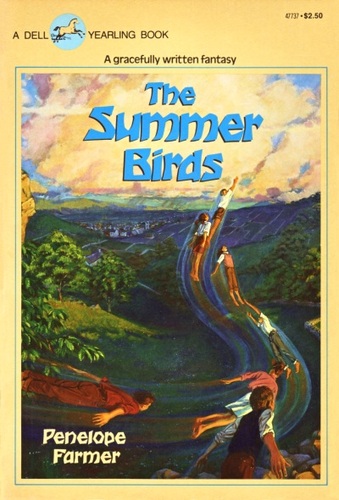 As a child, I loved fantasy, and I never totally outgrew it. I think I've mentioned this before. As I grew up, I found ways to get "serious" about my interest, to justify it somehow, but... I recently re-read one of my early favorites, The Summer Birds by Penelope Farmer. I think I can finally admit that plain and simple I loved those stories for the vicarious experience of magic—a kind of hair-tingling, heart-pumping exhilaration. Just the idea that a kid could learn to fly. As I said a couple weeks ago in meeting, these were my miracle stories.
I wrote a couple of years ago about my time in the world of fantasy fiction as a young adult, and how I was kind of surprised to find the creators of these stories not to actually be wizards or Illuminati or whatever. But in reading Faces of Fantasy I see a sentiment among the writers I respect most that is a little like the Quaker line I keep coming back to, about how we abolished not the clergy but the laity. The point is that these writers are not trying to gather magical knowledge in order to empower themselves over others—they are trying to spread a sense of magic diffusely, to reintroduce it back into a culture that frankly doesn't know what to do with miracle stories. Which in turn reminds me of the interesting discussion on the Sheffield Quakers blog which eventually turned to the idea of magic in Quakerism.
Again, as I said in meeting, we Friends don't do miracle stories much. We try to be reasonable, and we try to speak truly from our experience. And I venture to say none of us has had experiences identical to the ones in miracle stories, old or new: literally walking on water, literally flying like a bird, literally returning from the dead.
When I've tried in the past to look critically at fantasy stories, I've tried to figure out what magic means in modern kids' fantasy fiction. Creativity, or aliveness to the world, maybe. Power, in some books. But what I'm seeing in revisiting the topic after some time away, is that fantasy books are, at heart, about Amazing Things Happening. How do Amazing Things change us? How do they pull us away from those who haven't experienced them? How do they push us to attempt Amazing Feats ourselves? How do they clarify the world, and how do they make it more confusing? And so on.
And here I go back to a line of questions I started asking when I first becoming a cartographer. At the time, I asked "Can a map be an independent work of fiction?" My conclusion is that while they can be used as part of a fictional game, or as an illustration to a work of fiction, maps can't stand on their own as works of fiction, because they don't stand on their own as works of fact. They need to refer to the real world in order to fulfill their purpose.
What about miracle maps? What would a miracle map be? I ask without a clear answer. But it's an interesting question.
I wrote a couple of years ago about my time in the world of fantasy fiction as a young adult, and how I was kind of surprised to find the creators of these stories not to actually be wizards or Illuminati or whatever. But in reading Faces of Fantasy I see a sentiment among the writers I respect most that is a little like the Quaker line I keep coming back to, about how we abolished not the clergy but the laity. The point is that these writers are not trying to gather magical knowledge in order to empower themselves over others—they are trying to spread a sense of magic diffusely, to reintroduce it back into a culture that frankly doesn't know what to do with miracle stories. Which in turn reminds me of the interesting discussion on the Sheffield Quakers blog which eventually turned to the idea of magic in Quakerism.
Again, as I said in meeting, we Friends don't do miracle stories much. We try to be reasonable, and we try to speak truly from our experience. And I venture to say none of us has had experiences identical to the ones in miracle stories, old or new: literally walking on water, literally flying like a bird, literally returning from the dead.
When I've tried in the past to look critically at fantasy stories, I've tried to figure out what magic means in modern kids' fantasy fiction. Creativity, or aliveness to the world, maybe. Power, in some books. But what I'm seeing in revisiting the topic after some time away, is that fantasy books are, at heart, about Amazing Things Happening. How do Amazing Things change us? How do they pull us away from those who haven't experienced them? How do they push us to attempt Amazing Feats ourselves? How do they clarify the world, and how do they make it more confusing? And so on.
And here I go back to a line of questions I started asking when I first becoming a cartographer. At the time, I asked "Can a map be an independent work of fiction?" My conclusion is that while they can be used as part of a fictional game, or as an illustration to a work of fiction, maps can't stand on their own as works of fiction, because they don't stand on their own as works of fact. They need to refer to the real world in order to fulfill their purpose.
What about miracle maps? What would a miracle map be? I ask without a clear answer. But it's an interesting question.
Subscribe to:
Posts (Atom)
