Saturday, February 12, 2011

The poison of "The People"

It's a well-known fact that the name of many "tribes" and "nations" is simply the word "people" in that group's language. The implication being that we are people, and then there are those other not-quite-people who we can't even understand.

Populist and socialist politics did much the same in the era of popular revolution: "We the people" overthrew the British royal government in what became the United States. Communist revolution established "People's Republics" all over the globe. "People power" toppled Ferdinand Marcos and has been a byword for popular revolt ever since, including the ongoing changes in the Arab world.

I was struck again this morning by how that language permeates Bob Herbert's warning opinion piece this morning in the New York Times.
I had lunch with the historian Howard Zinn just a few weeks before he died in January 2010. He was chagrined about the state of affairs in the U.S. but not at all daunted. “If there is going to be change,” he said, “real change, it will have to work its way from the bottom up, from the people themselves.”
The problem is, of course, that what "the people" rise up against is, well, other people. And there's a thread in liberal thought that emphasizes the unity of homo sapiens (and more recently, the whole earth as one ecosystem). But we still have this idea that "the people" will empower themselves... and as we've seen in the last few weeks in Egypt, when the bulk of the population finds itself utterly at odds with a ruling elite, they will in fact do just that: take back the country.

So what's next? That's the theme of commentary over the last couple days, as Mubarak's exit seemed clear to everyone but himself. And I think part of the answer lies in how "the people" comes to be formulated in Egypt's new formal political and social structures. Nasser founded the modern Egyptian state on rhetoric of popular nationalism, borrowing heavily from his Soviet sponsors. Like those sponsors, it was in large part a smokescreen for oligarchy, and as the socialist pretense wore thin and was eventually dropped, the "people" that the Egyptian state was supposed to be founded on found themselves adrift.

----

"The People" is a powerful concept. It makes every human an equal component of the group in question, whether it is a nation, clan, religion, association, or rock band. But it also implies a false dichotomy whenever it is invoked: we are more human, they are less human. And whether you are dealing with class struggle or inter-national conflict, it dehumanizes.

As a concept, the equality-making "People" is offset by how we humans generally self-organize: with leaders and followers. The feudal model, of a king and his lieges, is the other extreme of a pure democracy, but both need the core element of the other: without leadership, a nation is like a ship without a helmsperson, drifting aimlessly. It can get along fine in calm waters, but watch out when a reef arises—and a reef will inevitably, eventually, appear. Likewise, when a purely power-based king forgets that he depends on his lieges' loyalty, and that that depends in turn on a feeling of commonality, he'll be chucked overboard at the first opportunity, like Captain Bligh...

European nations, and their political heirs, have been struggling with this balance for centuries. Do we endow a king with god-like power? Consensus seems to be that a constitutional balance is better in the long run. Do we let anyone run for president? Hitler was popularly elected, and most democracies have exceptions for parties or leaders who explicitly want to undo democratic institutions (remember the presidential oath to "uphold the Constitution" etc.?). And on and on...

What I find intriguing and kind of exciting is the potential of the current revolution in Egypt especially to change the nature of global political thinking. Islam, unlike Christianity, has an inherent, core philosophy of radical equality: we are all equal before Allah. There is no Islamic Pope, no priestly intermediaries. There are wise scholars, and there is the Prophet, but the structural basis for a "God-given mandate" is really a lot thinner than in the West, reserved for fanatics like bin-Laden. So we will see.

In the meantime, could we in the West please watch out for invocations of "the People"? Please? Remember Louis Armstrong's comment:

"All music is folk music. I ain't never heard a horse sing a song."
Despite what you may have read, we've never had a horse as President or CEO either. Let's find some other way of saying "the people who are not in a leadership position, who are oppressed by those above them in power."

We are all the People. No exceptions.

Wednesday, January 19, 2011

Mid-January

They warn us of the cruelest month—
April with its chill, withheld promise;
And they tell us the veil grows thin on All Hallows Eve,
a shiver in the year's circle.

But what about January?
When the world itself is worn thin,
And we venture outside swaddled, wobbling like penguins.

The lucky ones travel south.
"Snow birds," as if magically transfigured.
And the rest of us? Carp frozen into the lake bottom.

There's no drama to this cold.
It's dull and it dulls the mind's knife:
The routine, the wind, the utter lack of scent.
All the little dailies and monthlies,
The clockworks of our lives
Spinning around in the dry arctic silence.

Flame is good.
Candles at dinner; a fireplace, a bonfire.
Hot coffee, chocolate, whiskey.
Hearthed or cupped, held clasped
As if it might run off into the darkness without us.

And in the dark bed, a warm body,
All the warm bodies, lying in wait for the air to warm between them.

Friday, December 31, 2010

Great Work of Time

Who hasn't run into old Shelley's "Ozymandias" in an English Lit class, the ruined claim of eternity disintegrating back into sand. We think we are free of the pride of our permanence—the mortality of ourselves and our endeavors gets drilled into us over and over: hubris and vanity and the problem of seeking immortality (cf. Voldemort).

I just finished rereading John Crowley's Great Work of Time, a compact, melancholy and thorough dismantling of the idea of an eternal empire. It's a time travel story in baldest terms—one where the attempt to make the British Empire truly eternal, the protector of world peace and preventer of the horrors of the twentieth century, turns out to make the world go horribly wrong: the future fills with monsters and angels, a strange and unnatural stasis that in the end is imagined as a silent forest underwater, forever still and unchanging. The angels and the wise magi that the messing with time produces, do not want to have been created. They long for death.

We mapmakers make some claim of permanence—more modest than eternity, but what I take away from Crowley's book is the false seductiveness of the idea that what lasts beyond our lives lasts forever. We don't know what happens after "The End," and so we imagine a universe that never ends, an empire on which the sun never sets. An immortal soul. Streets that are somehow permanent. But someday the streets in my neighborhood will become meaningless. It might be a very very long time (in doing research this week I realized I will likely live to see the basic streeet pattern of Harvard Square celebrate its 500th anniversary), but there is no such thing as "forever", only "over the horizon." I don't think there is anything, anyway.

Maps only act as a way of contrasting relatively transient with relatively permanent phenomena: the states shapes remain the same as votes move from bloe to red and back again. Streets remain the same as taxi routes wiggle back and forth across them. Continents retain their rough outlines as glaciers push forward and retreat.

We need ground to stand on—a stage as I've said before, here—in order to make our performances and arguments. People who have attempted to eliminate that stage in the name of acknowledgining our impermanence have unleashed a peculiar kind of madness we see in some kinds of modern art and philosophy. Eliminate permanence, and there's no "there" there, as Ms Stein said. Perhaps the answer is to sadly acknowledge that our stage, our permanence, is itself impermanent, and find a platform that fits our lives, and the terms of permanence we can find— the land that stays more-or-less the same between glaciations, the nation that for a while retains the same basic shape, the family and friendship we have for the span we are lucky enough to have it.

Happy New Year, all. Here's to what permanence we can muster in the coming year, and what good we can perform upon that permanence.

Sunday, December 12, 2010

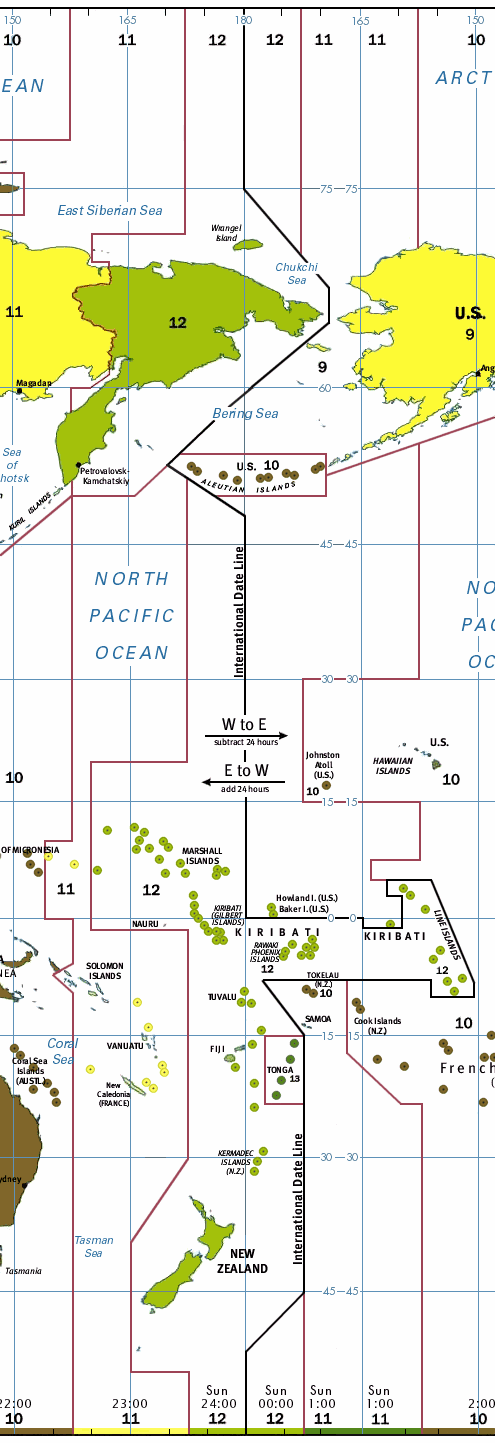
The International Date Line

My son asked a random back-of-the-car question the other day, about whether there was a place where the day changed too, not just the time. There is, of course, and it's the International Date Line, more-or-less located at 180° longitude, opposite the globe from the Greenwich meridian. (the picture attached is from Wikipedia)

What I found interesting about the question, though, was how the idea of such a line requires a leap of how we think about time. For most of us, time is local: our makers are sunrise, noon, sunset, midnight. Like the Archimedean, Earth-centered model of the universe, and like earth-navel cosmologies, it makes "us and ours" the center of all things, both in space and time.

20 years ago, I took a course at Carleton College from the late Mike Casper, "Revolutions in Physics," that was mocked by some as "Physics for Poets." Which isn't really fair, although I can see the case that it really was as much a history of science course as anything. The course was divided into three sections: the Archimedean, earth-centered universe, the Newtonian universe, and the Einsteinian universe. The goal of each was to immerse the students in what historically were comprehensive worldviews. And it worked. It was fascinating how useful the oldest model, the one we've mocked as "wrong" since grade school, really is.

It's of course incorrect that the sun goes around the earth, but there's a lot to learn about seasons and the sun's movement in the sky if you think that way. And I became aware that I simply had not paid that much attention to how the sun moves in the sky over the years. For example, that it is always due east or west at 6 o'clock (either one) local time. Or that the angle of the sun's path is constant in the same location, but that the constant-angled path moves up and down vertically with the seasons in relation to the horizon. I dunno, maybe everyone else got that from day one, but it was new to this college student and it was cool, and it depended on thinking locally.

The Copernican/Newtonian model of the universe that shifts this around. Suddenly, we're on a planet, and really there is only one day, and it keeps rotating around the globe—or rather, the globe keeps turning and the day is the glow from the star at the center of our solar system. Instead of the sun as a clock that keeps our time, we are fixed points on a moving sphere, which keeps its time in turning us and everything else in the world.

And it's in this world that International Date Lines become necessary.

Interestingly, it wasn't scientists who first proposed such a line. It was an 11th-century Jewish scholar, who was concerned that all the Jews in the diaspora should observe the same Sabbath, and so proposed a system which kept the same day-observance for all of Asia, and made a break somewhere in the Pacific. The "Circumnavigator's Paradox" was in fact a real paradox, discussed in the late middle ages (see the excellent History of the International Date Line for much of the source material in this post): Apparently it surfaced when Magellan arrived at the Spanish outpost in the Philippines, having come from the east by way of Cape Horn, and disgareed with the Spanish officers there, who had come from the west, via the Cape of Good Hope. Their dates, of course, were off by one.

In a world where one set of grandparents is an hour earlier and another is an hour later, and where we can fly to Europe where it's six hours later, it's commonplace to think about time zones. But it was not always so. It was not until railroads needed to keep precise time in their east-west journeys that the need for standard time became apparent. Before the railroads, punctuality was enforced within local communities. A parishioner coming to church on time, or a worker arriving at the mill, or any citizen keeping any of the other appointment-keeping arrangements we make, either had to judge by the sun, or by the bells of the church tower, or later by the local-time clock or sundial, how close they were going to cut it. And travel, by foot or horse, essentially re-set the clock.

By instituting standard time, we essentially said, railroad time is more important than where the sun stands in our sky.

And much the same thing, on a global level, happens with the International Date Line: we are forced to recognize that this is a round, whole planet, which moves in one time, simultaneously. And for better or worse, this means we depend less on what we see—here and now over our heads—to regulate our lives by.

Friday, November 5, 2010

Singing Dark Songs

I like singing, and do it when I can. Actually, I really like the dark, bloody ballads, "Cruel Mother" especially. And sad, bittersweet Scots songs (there are a lot of those).

About ten years ago, I asked my friend Paul if he knew of any Guy Fawkes parties, and he said, no but there should be one, and here we are, ten years later, at his and Darcy's house in suburban Minnesota, hurling poor old Guy on the bonfire again. Every year that I've made it, I've been asked to sing the old song that goes:

As I was out a-walkin' in the fields
I met a man as black as his heels
He asked me if I would not fight
With his face and hands as black as night.

Chorus:
Guy! Guy! Guy!
Stick him up on high!
Stick him on a lamp-post,
And there let him die!

Holla, boys, Holla, boys,
God save the Queen!
Holla, boys, Holla, boys,
God save the Queen!

So here's a loaf to feed the Pope
And a hunk of cheese for him to choke
A pint of beer to wash away sin
And a good old fire to roast him in!

Chorus

So give the poor Guy a penny
For you know he hasn't any
If you haven't got a penny, a ha'penny will do
If you haven't got a ha'penny, God bless you

Chorus
After a couple years, I got more and more uncomfortable singing this song. Guy Fawkes was executed for trying to blow up the Houses of Parliament and basically all the power elite of 1608 England. He was, in short, a terrorist and assassin. So, not a nice fellow. But the song doesn't remember that (the other famous bit of doggerel does: "Remember, remember, the Fifth of November! Gunpowder, Treason and Plot!"). No, the song remembers that Mr Fawkes had dark skin (but probably not African-dark, just Italian-dark) and was a Catholic. That, in the opinion of those who wrote and sang this ditty, was enough to get you roasted. Bleh.

And yet I sing it, because I also hate it when we forget how mean and nasty we can be, when we congratulate ourselves for becoming "nice." Not to sing it is to paper over history, making Guy Fawkes into a generic "Bonfire night" with no real context. For a few years, I'd preface it with a little speech that was meant to distance myself from the song, and sober us up. This year I just sang the damn thing—Paul said "and without further ado..." in introducing me, and I didn't have anything planned, so I figured what the hell. And about half-way through, I realized, this thing needs one more verse. I'm fast, but not that fast, so it had to wait until I was in the car on the way home:
Guy Fawkes is dead and so's the king
Four hundred years, and still we sing
The bonfire's burning, red and hot
Who the next to be tossed on, ready or not...?
I feel a little better about singing it next year...

Thursday, October 28, 2010

Volcanoes are not the same

I had a longish list of subjects to talk about in the wake of the NACIS conference, but what I keep coming back to again and again is the uncomfortable feeling that "map" is somehow the wrong ontology—the wrong conceptual category—for what I am really interested in.

What I mean is the sense that's been growing in me, kind of under the surface of my everyday cartographic life, that the thing I claim to specialize in is like a dolphin leaping in and out of the water. Or maybe more accurately, it's the way we call certain geologic phenomena "volcanoes" as if they're one sort of thing, based on what they look like, rather than what processes they represent.

"Map," especially when equated with modern scientific cartography, is a form of expression. It's a technique and style of drawing. And on the surface it seems to have a generally unified subject matter: the surface of our planet. That at least is the definition you get if you abandon the the search for a categorical definition and fall back on a cognitive, examplar-based definition (see my earlier blog post.

But in the end this posits maps as a kind of object, rather than a kind of function. And if you look at a tradition of mapping, any mapping, you end up finding curious gaps: I'm thinking especially of the gaps in early maps for navigation, which Catherine Delano Smith documented in her article in Cartographies of Travel and Navigation (James Akerman, editor), which I reviewed in Cartographic Perspectives a couple years ago (PDF here). As I summarized:
Catherine Delano Smith, in the second article, discusses the origins of the modern road network map in medieval and early-modern European itineraries. These were largely textual until the late eighteenth century and did not evolve into visual tools for independent way finding until the nineteenth century. This came as a revelation to me; an almost map-free travel network is hard to imagine today, but Smith makes it clear that the use of maps as a basic tool for land travel is a modern development.
And yet, there was clearly navigational knowledge being passed along. Presumably it was passed along orally, and more importantly through repeated action: palmers learned the pilgrims route by first being an assistant to a pilgrimage's guide, then eventually leading groups themselves.

So if we think of maps as function rather than object, they become part of a continuum with other sorts of things. All sorts of things. All sorts of unrelated things. "Geographical knowledge," as a concept is an ontological pea soup [insert joke about AAG conferences here] and not all of it relates to maps at all... as those who have looked at maps for expressions of poetic sense of space have found to their detriment—some kinds of knowledge are in fact mutually exclusive of cartography—again see my discussion of cartography and the fine arts (PDF here)

No, I think what we have is something a little like "publishing," an interesting term used to describe a particular way of distributing knowledge. Like maps, some kinds of knowledge bob up and down in and out of publishing, while retaining their integrity: poetry is poetry whether it is recited in a non-literate society, scribbled privately in a diary, or published in books.

There are some classes of knowledge that sometimes pass through maps, and which we've gotten used to almost equating with maps. Navigation, for example. Human territory. The shape and texture of the surface of the earth. How people are scattered around the planet. How would we talk about these ideas without maps?

We use the word "house" to describe a thing by its function: wasps' nests, tepees, chateaux, the inner sanctum of a temple. Can we think about doing that with maps? Can we, the map people. let go of the term in the way that most writers end up doing the work and not worshiping the object? Can we think about:

Guides: communicators and communications to help strangers find their way through unfamiliar territory—and most of our territory is unfamiliar, even most of the cities we call home. Hedberg Maps make maps that have helped me find things in my home town of which I was unaware. But so have pieces of narrative prose, signs and markings on pavement, conversations, tours, and just walking around and learning the landscape through repetitive exploration.

Territory markers: It's the claiming of areas of land that generally gets cartocritics most het up. The way people can draw a line across a map and so divide up the world, without actual engagement with the land itself. But people were claiming territory long before cartography; indeed the bloody wars of the early early modern period— the Crusades, the Hundred Years War—were fought largely based on non-graphic ways of understanding the lay of the land. We mark our territories in a variety of ways, both with "permanent" physical barriers and boundary markers, and by social communication. As with navigation, signs and other "on the ground" graphic and textual clues are a kind of counterpart to mapping, providing a "civilised" alternative to dogs chasing you out of the yard.

Travelers tales: One of the things maps do is tell us something about territories we've never visited. The stories modern cartography tells are mostly grounded in documentary factuality, but the way we can read shaded relief or a map of ruins can stir the imagination in the same way that tales of Prester John and the Unipods did people centuries ago. And there is no shortage of other material that does the same: nature documentaries, travel photography, the stories we hear from friends...

Economic planning tools: statistical maps are mostly about (in a broad sense) the economy. By this I refer the original source of the word "economy", the Greek word οἶκος — house, household or family. Oἰκονομία means "household management," and the way we understand what is where in our increasingly broad collective household is part of a larger set of tools that gets people fed, warm, clothed, and otherwise provided for. In this sense, a statistical map is part of the same toolset as a spreadsheet, a shipping container, or the Federal Reserve's policy: they are all about recording and moving value.

I could surely come up with more, but then so could you. The point is, we cartographers do end up often hanging onto our technical expertise at our proclaimed specialty. And maps are a valuable kind of tool to let us look at the world from a step back, to place ourselves in an ordered version of space, to make sense. But we would do well to be aware (and beware) how much we are focusing on the sense rather than the thing we are making sense of.

Thursday, October 21, 2010

Tecumseh Sparrow Spivet

[Note: this article presumes reading the book, and contains spoilers]

I have a few things to say about The Selected Works of T.S. Spivet.

The novel was a best-seller when it came out in June of 2009, and initially received press attention because of the monumental advance the author Reif Larsen received for this first novel ($1 million). The reviews were mixed: most reviewers wanted very much to like such an unusually eloquent and evocative voice, but several (notably the New York Times and Washington Post reviewers) found the latter part of the book, especially the parts where T.S. Spivet visits Washington, disappointing.

Well, to be honest, they weren't my favorite bits either. But then, they also weren't T.S.'s favorite, and it kind of shows. The book, like most maps, doesn't entirely work as a linear narrative. It's a puzzle in which the linear progression of time and plot, while certainly straightforward (this is no Memento), is not the dominant, salient feature. Really, the most important moment is about 2/3 of the way through, when, at the conclusion of reading his mother's reconstruction of his great-grandmother's early life story, she abruptly cuts off the narrative, writing the name of T.S.'s dead brother, who perhaps died as she was writing. In this sense, it's a little like the symmetry of Coleridge's "Rime of the Ancient Mariner", where the second half of the novel has the character working his way from that crux point, the nowhere of a midwestern wormhole, back to his family. Coleridge's Mariner's return journey also suffers somewhat...

The way T.S. simultaneously orbits his brother's death and avoids it that forms the central motion of the book. And an orbit is hardly a linear path: we return again and again to the same basic relationships: T.S.'s distant, formal relationship with both his scientist mother and cowboy father, his typically exasperated coexistence with both his living and deceased siblings, his obsession with drawing diagrams and maps as a way of making sense of the world, and the utter senselessness offered up by the world that he tries to map.

---
This is the second book about map people I've read this year. Unlike the author/subject of Map Addict (see my discussion here), the fictional narrator of this book is consumed by the promise of mapping and more generally of scientific study of the universe. It's appropriate that the character be a child—a prodigy with an disturbingly grown-up diction (and who has not known children with disturbingly grown-up diction)—but it is also notable, and lovely, to see a cameo appearance by Corlis Benefideo, the subject of Barry Lopez's short story "The Mappist" (see discussion here). And it's clear that Larsen wants his hero to be like the narrator's daughter in that story—the promise of a new generation who will humbly carry on the Work of mapping the world, piece by piece.

It's not how us cartographers usually see our role, any more than "making myths" being how novelists consciously view their craft as they go about it from day to day. But Larsen is pointing in this circular, spiraling book to the same basic sense Lopez pointed to: the humble recording and exploring and searching and the piece-by-piece processing of it all, is a kind of prayer to the universe. It's a kind of love.

So it really is a peculiar novel. It points toward what it's trying to say, leaving the largest points mostly unsaid, like notes at the edge of the map saying this destination is a certain distance further. We find a genius cartographer running into things that are unmappable and yet that mapping is his tool. We see a desire to be part of a great scientific enterprise crumbled into disillusionment, but not disillusionment with the enterprise, just with the clothes it has to wear—T.S. may be saying goodbye to the Smithsonian and to Washington, but not to the idea of the Smithsonian.

I keep seeing these sorts of orbits underlying some of my favorite books. The orbit in Diana Wynne Jones' Fire and Hemlock is deceptive—it's a love story that orbits a kind of modernist despair. Here, the obvious suppressed and not-so-suppressed grief over T.S. brother's death looks like the focus of the orbit. T.S. clearly thinks it's what he's circling. But in the end, what is revealed a kind of stubborn, slow trust that some of the world is comprehensible. Even the terrible, stupid meaninglessness of his brother's death. In the end, the author (and narrator) point towards the love of parent and child, the care even the most scientific of us end up showing each other, that he has been circling, unaware, for the entire novel.